
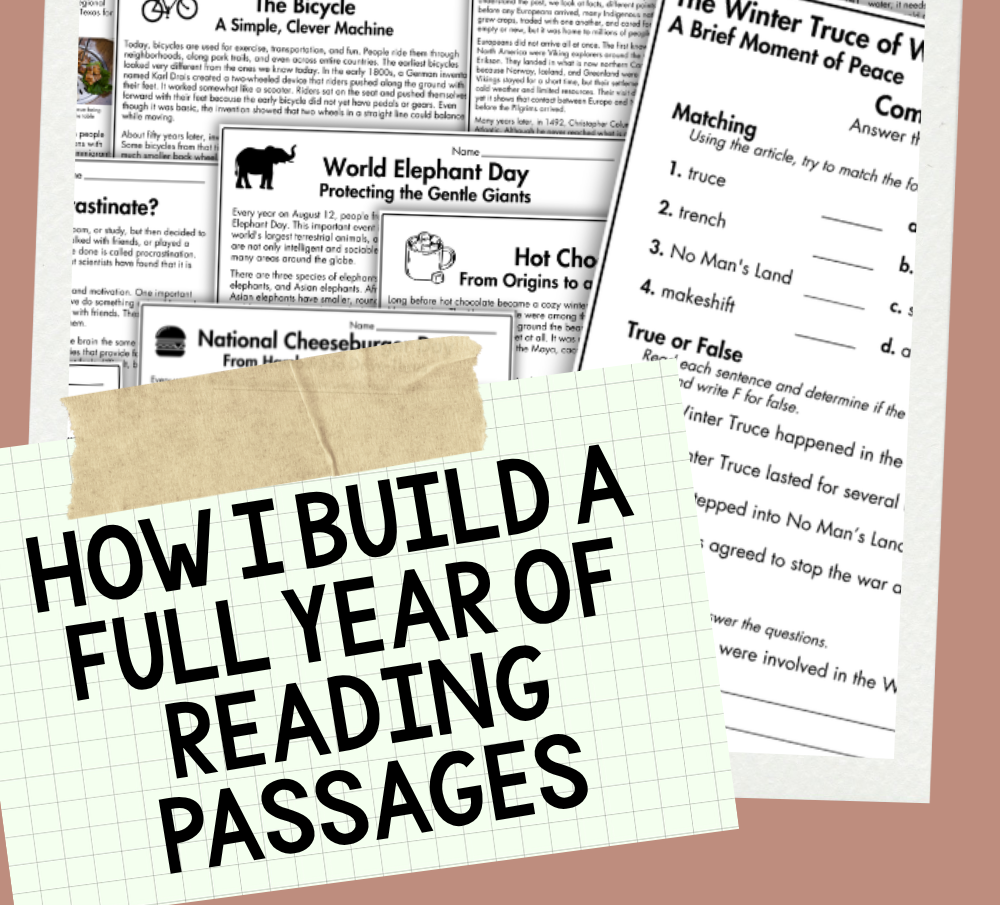
Some people ask me how I put together nonfiction reading passages for the year without running out of ideas or repeating myself. I didn’t write all sixty passages in one sitting. Series 3 came together one month at a time, over more than a year, and that’s actually why it holds up as a full year of reading.
Why five passages a month
Every month in this series (and others) follows the same shape. Five short nonfiction passages, one page each, with a comprehension page and an answer key attached. Five wasn’t a random number. It gives a teacher one passage for each day of the week without feeling repetitive, and it’s small enough that I can hold every topic to a real standard instead of padding for volume.
How a month's topics get picked
Every month has to hit at least one of four angles: science, history, culture, or something genuinely surprising. I look at what’s happening that month, the holidays, the seasons, the things kids already notice, then check which categories are missing. If August already has two science topics, the third one needs to come from history or culture instead. That rule is why a full year of this series never turns into sixty science passages in a row.
Some of my favorite topics came directly out of that constraint. Left Handers Day in August isn’t something I would have thought to write about on my own. Neither is the invention of the umbrella, or how candy hearts became the go-to gift of love. Those tend to be the passages that seem to stick with kids longer. Maybe because nobody expects a reading passage to teach them something that specific.
Two bundle formats, same readings
Series 3 comes in two versions: PDF Only, and PDF paired with Google Slides. Grab whichever one actually fits your week. If everything gets printed and handed out, PDF Only keeps it simple. If any part of your reading block runs digitally, the Google Slides version (11×8.5) gives you the same sixty passages ready to assign without extra prep.
Either way, the structure stays the same. Twelve months, five passages each, a monthly set for every month, and answer keys built in from the start. Buying the full year at once works out cheaper than grabbing each month separately, though plenty of teachers start with just the months they need and build the rest of the year from there.
Where this full year of reading passages leaves you
Series 3 doesn’t repeat a single topic from Series 1 or Series 2, so if you’ve used either one before, this full year of nonfiction reading passages gives your students something new to dig into. And if this is your first time trying any of the three, none of them depend on each other, so this is just as good a place to start.
I still remember writing the very first Series 1 passage, long before I knew it would grow into sixty. Let alone that it would eventually turn into Series 3, closing out at the 180th passage. That’s honestly one of my favorite parts of this job. You start with one topic you can’t stop thinking about, and a year later it’s turned into a full year of no-prep reading.
Try it yourself
You don’t need sixty passages to start. Pick one topic you can’t stop thinking about, write it up, and see where it takes you. That’s really all Series 1 was which evolved into now three full year series.
Writing your own, not your thing? Don’t worry, take a look at how the whole year fits together, month by month, right here: