Most teachers know that getting kids to actually engage with nonfiction reading is half the battle. Choosing the right nonfiction reading topics for elementary students can mean the difference between a class that’s locked in and one that’s checked out. You can have a great passage with solid comprehension questions, but if the topic feels like a chore, students tune out before they finish the first paragraph.
The fix isn’t complicated. It’s about picking the right topic.
Not broad topics. Not obvious topics. Specific ones. Ones with a little surprise built in.
Why the Best Nonfiction Reading Topics Are Specific (and a Little Surprising)
When a teacher says, “We’re reading about animals today,” students know what that means. It’s fine. It’s school. They’ll get through it.
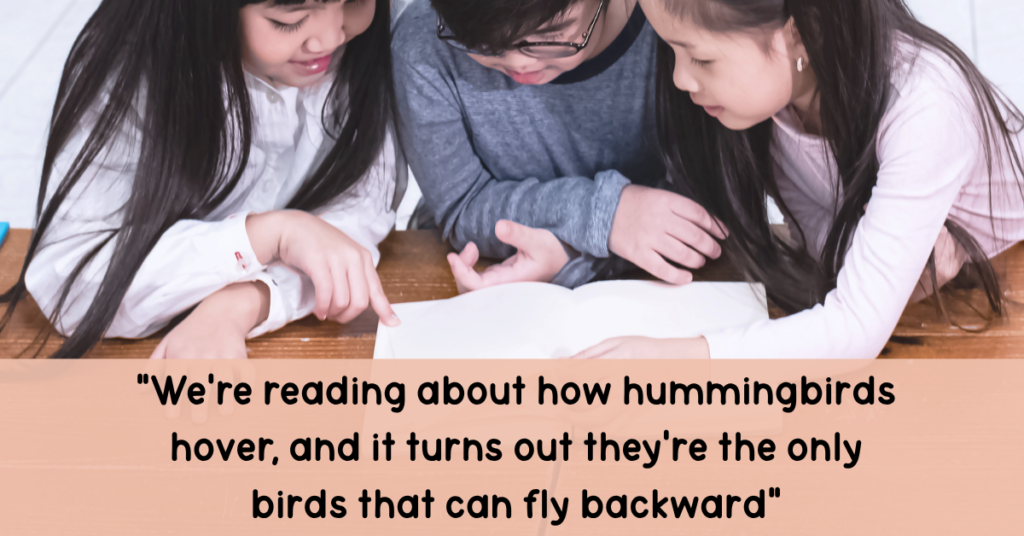
But when a teacher says, “We’re reading about how hummingbirds hover, and it turns out they’re the only birds that can fly backward,” something different happens. Kids look up. They want to know how that works.
That’s the specific topic effect. And it’s not a trick. It’s just good nonfiction reading practice. The research on background knowledge consistently shows that students comprehend and retain more when they care about what they’re reading. Curiosity is doing real cognitive work.
The problem is that “specific and surprising” sounds harder to find than it actually is. You don’t have to go far. The specificity is often hiding right inside the broad topics you’re already covering.
How to Find the Specific Angle
Take almost any broad nonfiction subject and ask: what’s the weird detail inside this?
Power of sleep becomes: why is sleep important, and how does it help with memory?
The bicycle becomes: how one invention changed the future.
Rachel Carson becomes: the scientist who got called hysterical for telling the truth, and changed the world anyway.
National Police Week becomes: what police technology helps them get their work done.
None of those require finding a completely different topic. They just require going one level deeper into the topic you already had.
That’s the goal with every reading passage I write. Not to cover a subject. To find the angle inside the subject that makes a student think: wait, really?
A Quick Tip You Can Use Right Now
Next time you’re planning a nonfiction reading, try this: write down your topic, then write three “wait, really?” facts about it. The most interesting one on that list? That’s probably your angle.
If you can’t find three, the topic might be too broad. Go one level deeper. If all three are interesting, you might have material for more than one passage.
What This Looks Like in the Classroom
Once you find that specific angle, a few things get easier.
Comprehension questions feel more like conversation and less like a quiz. When students actually want to know more about the topic, questions like “what surprised you?” or “what would you want to find out next?” stop being filler and start generating real discussion.
Writing responses get better. Students who are genuinely interested in what they read have something to say. The connection between reading and writing is real, and specific nonfiction topics are one of the easiest ways to activate it.
Reluctant readers get pulled in. A student who says they hate reading will often sit down for a passage about something they didn’t know existed. Specific, surprising topics are among the best tools for reaching kids who’ve decided that reading isn’t for them.
How I Plan Topics for Reading Passages
When I’m planning a new set of passages, I start with the month and then brainstorm every possible topic angle, like awareness months, historical events, scientific phenomena, food history, cultural traditions, and notable people. Then I filter.
Every topic has to clear at least one of these bars: science, history, culture, or surprising perspective. If it clears more than one, even better.
That filter is part of why I’ve now built three complete series of passages. Each one covers the same month, but no two passages overlap. Fifteen different topics, fifteen different entry points into nonfiction reading every month! This month is May, so let’s take a look at just these!
All Three May Series at a Glance
Series 1 — May Reading Passages May Day: Spring Festival and Workers Day (history), Cinco de Mayo (culture), World Turtle Day (science), Science of Rainbows (science), Asian American and Pacific Islander Heritage Month (culture).
Series 1 leans into awareness months and cultural celebrations. Good fit if you want to connect reading to the broader school calendar and tie into heritage month recognition.
Series 2 — May Reading Passages Fireflies (science), The Story Behind Mother’s Day (history), School Lunch Hero Day (culture), Memorial Day (history), Summiting Mount Everest (science).
Series 2 has a strong mix of science and history with a few cultural touchpoints. The Everest and fireflies passages tend to be favorites, specific topics with a lot of interesting detail to unpack.
Series 3 — May Reading Passages Hummingbirds (science), The Bicycle (history), Rachel Carson: A Voice for Nature (history and science), The Power of Sleep (science), National Police Week (culture).
Series 3 is where I leaned hardest into the “surprising perspective” angle. These are topics that don’t always show up in May lesson plans, but every single one has a hook that pulls students in.
How to Use All Three if You Already Have Them
If you’ve been collecting these series over time, you’ve got options. Some teachers rotate a different series each year so their students never hit the same passage twice. Others pull individual passages across series to build a custom set for a specific reading group or skill focus. And some use all available ones for the whole month! The passages are all independent, there’s no required reading order within a series, and they don’t build on each other across series either. Use them however makes sense for your class.
Where to Find Them
All three sets are available in my TPT store. Each one includes five passages with comprehension questions and an answer key. Print and go! No prep needed beyond printing.
Also, if you’re not already on the email list, the Freebie Vault is free to join and has a new summer-themed reading passage added this month. Sign up here
For Full PDF and Google Slide versions of full years worth of Reading Passages check out these: Full Year Sets
Full Year BUNDLE w/Google Slides Series 2
Full Year BUNDLE w/Google Slides Series 1
Follow me on Teachers Pay Teachers to stay updated on the newest sales, discounts, and freebies!